Arming Women in 2026: A Guide to Female Gun Ownership
You're free to republish or share any of our articles (either in part or in full), which are licensed under a Creative Commons Attribution 4.0 International License. Our only requirement is that you give Ammo.com appropriate credit by linking to the original article. Spread the word; knowledge is power!
Quick Takeaways: Female gun ownership in the U.S. is on the rise. This guide helps women understand important aspects of gun ownership and self-defense.
-
Situational awareness and threat avoidance are fundamental tactics for self-defense.
-
Federal and state gun law knowledge is essential for gun owners.
-
Purchasing a gun, holster, and ammunition is more straightforward than you might expect.
Top Ten Self-Defense Tips for Female Gun Owners
Having a defensive mindset, learning to use your firearm, and empowering yourself to take control over bad situations requires knowledge and practice. This list covers threat aversion, shooting tips, the legalities of gun ownership, and other basic info you will need to begin building real defensive skills.
#1: Situational Awareness
One of the simplest and most effective self-defense tactics women can use is situational awareness: knowing and understanding what is happening around you.
Criminals often target victims they can easily overpower, with a preference toward unsuspecting victims.1 That's where situational awareness will give you an advantage. When you're paying attention to your surroundings, your body language can communicate "I am not an easy victim" to a potential threat.
This skill can be honed before ever purchasing or carrying a firearm. Here are our tips for building situational awareness:
- Familiarize yourself with Lt. Col. Jeff Cooper's color code of awareness: white (unaware), yellow (relaxed and alert), orange (alert to a threat), red (ready to act in response to an active threat). When in public, it's best to stay in yellow.
- When in public, pay attention to possible exits, what people are doing with their hands, and anyone acting out of place.
- Walk with purpose. Don't use earbuds or stare at your phone, as either can signal that you are an easy target.
#2: Threat Avoidance
The best outcome for any defensive scenario is there being no need for defensive action at all. The two key threat avoidance tactics are trusting your gut and leaving a situation before it becomes dangerous.
"Trusting your gut" means trusting your instincts. For example, if a friend invites you out, you may feel tension, a vague sense of dread, butterflies in your stomach, or other indications that you're unsafe. Any of those sensations is sufficient justification to skip the outing.2
Using situational awareness to identify potential threats is paramount. If you notice someone fighting or becoming hostile, it's best to remove yourself before an escalation. If removing yourself isn't realistic, remain calm to avoid further escalating the interaction.
#3: Understanding Self-Defense and the Law
Understanding the laws and how your state handles self-defense shootings is imperative to avoiding unlawful actions. What may feel like a justifiable reason to draw your firearm may not actually be legally justifiable!
States with stand-your-ground laws may remove a duty to retreat if you're (A) in a place you're legally allowed to be, and (B) not committing a crime. Other states' laws may require a defender to attempt retreat before taking defensive action.
If you present your firearm in a threatening or reckless manner, you could be charged with brandishing. Only draw your firearm if there's an imminent threat that you intend to fire upon.
Before carrying, research city and county ordinances, state laws, and federal laws to ensure you don't face criminal charges for defending yourself with a firearm.
#4: Understanding Basic Gun Safety
Before you pick up a gun, you must know the four essential rules of firearm safety.
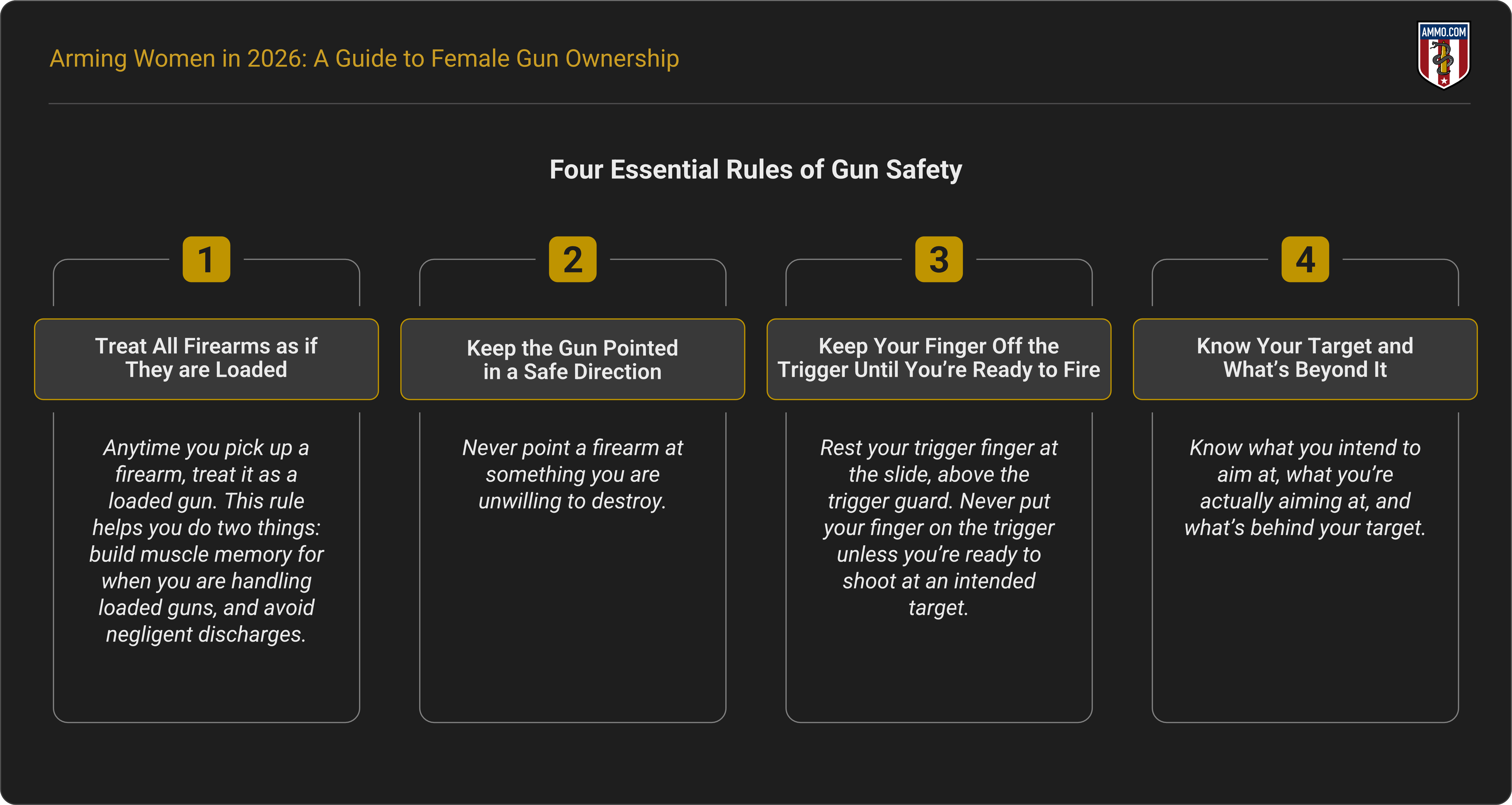
- Treat all firearms as if they are loaded - Anytime you pick up a firearm, treat it as a loaded gun. This rule helps you do two things: build muscle memory for when you are handling loaded guns, and avoid negligent discharges.
- Keep the gun pointed in a safe direction - Never point a firearm at something you are unwilling to destroy.
- Keep your finger off the trigger until you're ready to fire - Rest your trigger finger at the slide, above the trigger guard. Never put your finger on the trigger unless you're ready to shoot at an intended target.
- Know your target and what's beyond it - Know what you intend to aim at, what you're actually aiming at, and what's behind your target.
Learning and practicing these four basic safety rules will help you avoid negligent discharges and tragic accidents.
#5: Choosing the Right Pistol
Many female shooters struggle while figuring out which handgun is best. It's actually quite simple. Aside from one that is affordable, you're searching for a pistol that is reliable, convenient to maintain, and comfortable to carry and fire.
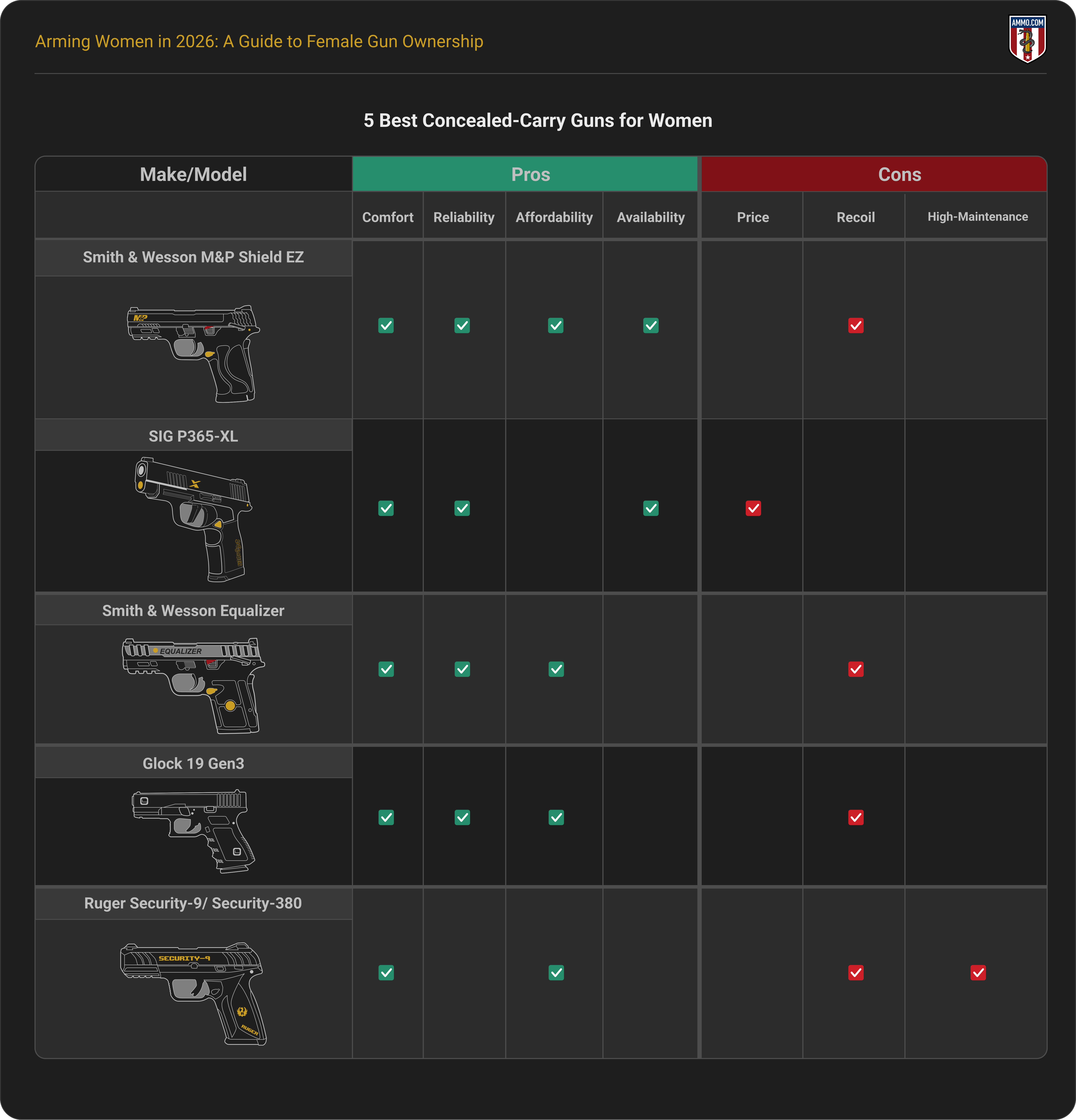
Before buying a gun, it's best to test out a few different options. See which one you like most. Here are a few of the models that seasoned female shooters say are the best for women:
- Smith & Wesson M&P Shield EZ
- SIG Sauer P365-XL
- Smith & Wesson Equalizer
- Glock 19 Gen3
- Ruger Security-9/Security-380
We recommend trying out all of those models. Some are more affordable than others, but they are all practical solutions to defense for women and men alike.
#6: Choosing the Right Ammo
You have many options when it comes to ammo, but you don't need to be an expert shooter to know what you need to get started.
Buying Ammo
Make certain you are buying the right ammo for your gun. Look at its slide or barrel, which should be engraved with the name of the cartridge it's chambered for: e.g. 9mm, 380 Auto (aka 380 ACP), 32 Auto (aka 32 ACP), 38 Spl, etc.
Once you have determined your cartridge, you only need to purchase two types of ammo: one for practice, and another for defense. A cartridge's intended application is defined by its bullet. Here are the two types of bullets every shooter must have:
- Full metal jacket (FMJ) - A simple bullet with a lead core and gilding metal jacket. The economical choice for target shooting, albeit suboptimal for defense.
- Jacketed hollow point (JHP) - A more sophisticated bullet, with a nose cavity that forces its tip to expand after striking flesh. The preferred choice for defense because it (A) inflicts more trauma to the threat, and (B) reduces the risk of over-penetration that could jeopardize bystanders.
Although FMJs are often used for target practice, it's a good idea to train with your defense ammo as well. Firearms can be finicky with JHPs, so take your chosen ammunition to the range to ensure your firearm cycles it reliably. Also, choose training ammo loaded with the same bullet weight (measured in grains) as your defense ammo. It won't perform identically to your defense ammo, but it will give you a closer approximation of your defense ammo's performance.
#7: Learning to Use Your Gun
The more comfortable you are with your gun, the better prepared you'll be to use it effectively. Between work, kids, family, and caring for a home, many women miss out on range time. Fortunately, there are things you can do to become more comfortable with your firearm right at home.
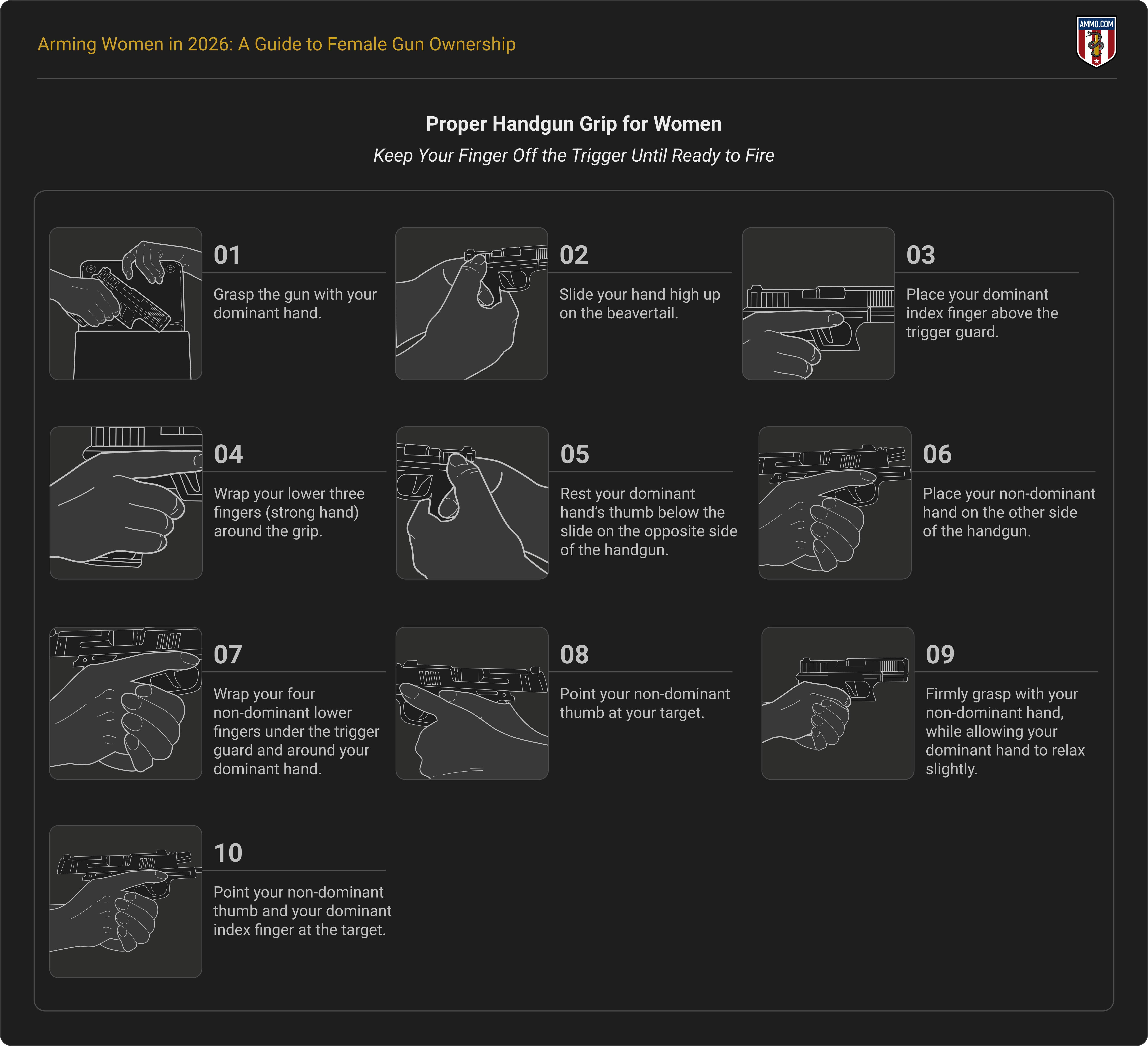
Here are our tips for training at home:
- Practice handling your firearm - MAKE CERTAIN YOUR FIREARM'S CHAMBER AND MAGAZINE ARE BOTH EMPTY. Once you have, you can safely practice drawing your firearm, ejecting and replacing its magazine, racking its slide, and operating its safety.
- Learn how your gun works - Know how to disassemble, clean, and reassemble your gun. Manufacturer videos and YouTube tutorials are great resources for mastering a specific firearm model. Be careful not to misplace small parts!
- Review the four basic rules of firearm safety - Commit them to memory. Obey them instinctively. Too many otherwise sensible people have caused tragedies because they failed to safely handle their firearms.
#8: Understanding Concealed Carry
Concealed carry is exactly that: carrying a firearm so it isn't visible to others. Many gun owners prefer concealed carry because it avoids unwanted attention. The only person your gun should worry is the one attempting to kill you.
If concealed carry is your preferred method, here are a few pointers:
- Know your state's laws - Some states require training classes and licenses or permits. Others have Constitutional Carry, but there are still rules with regard to where you can't carry (e.g. schools).
- Practice your draw - Concealed carry adds extra steps to drawing your firearm. Quickly clearing your clothes, drawing from your holster, and acquiring your target isn't easy without practice.
- Choose a practical holster - A holster is a crucial part of your defense strategy. Make certain to select one that fits your firearm, keeps it securely placed against your body, and is easy to operate.
- Practice concealed carry at home - Carry your firearm in your holster while you do chores around the house. This helps build confidence, and familiarizes you with concealed carry in a safe and controlled environment.
You can visit your state's website or call your local sheriff's office with questions about concealed carry laws.
Tips for Choosing a Concealed Carry Holster
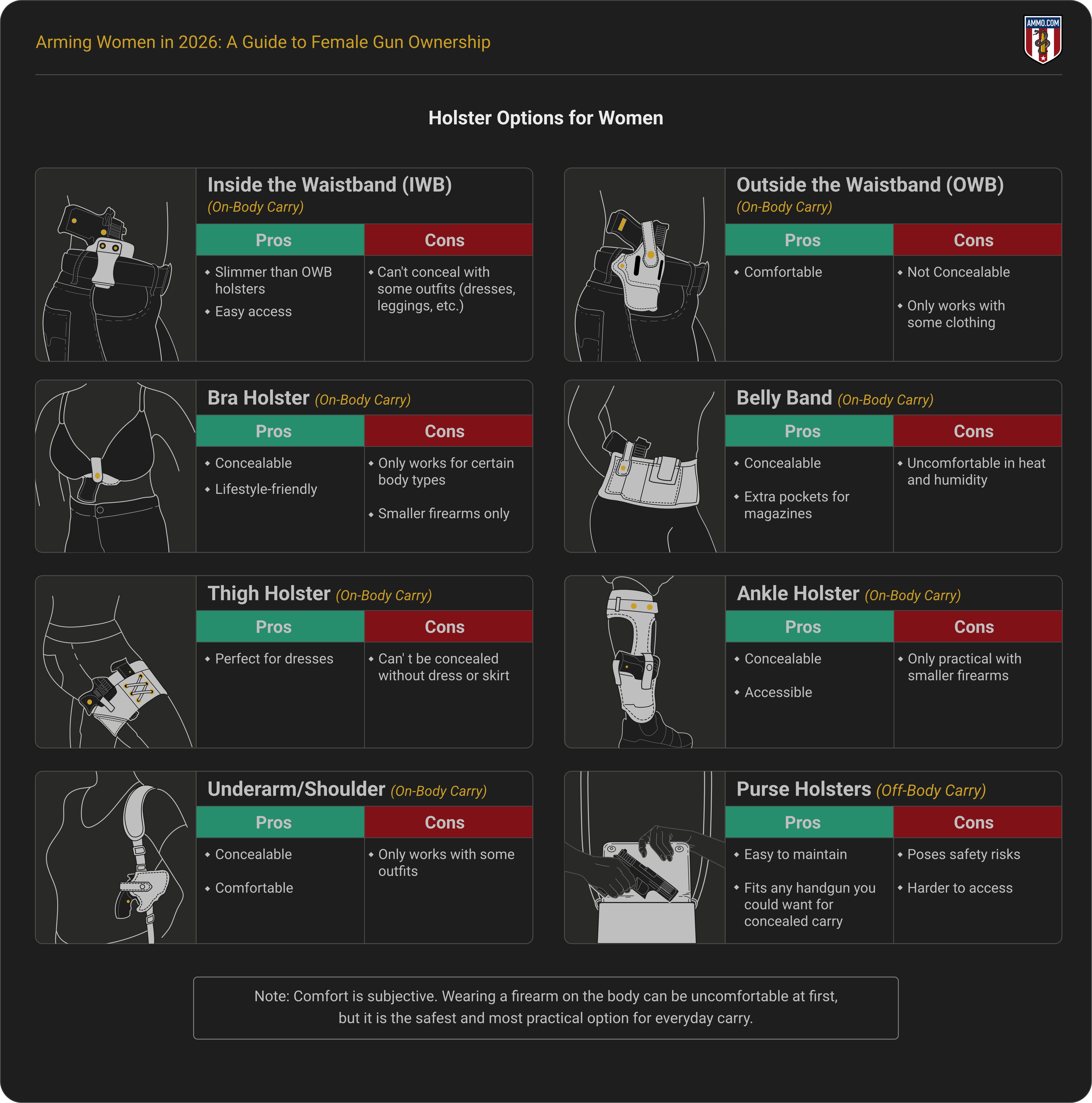
To choose the best type of holster, ask yourself these questions:
Q. Do you want to conceal your firearm when you carry?
A. For concealed carry, you want an inside the waistband (IWB) holster, purse designed for carrying a firearm, belly band holster, bra holster, or inner thigh holster (e.g. garter holster, compression short holster). For open carry, an outside the waistband (OWB) holster or drop-leg holster is best.
Q. Do you want your gun touching your body?
A. If you want your firearm secured on your body, an IWB, OWB, bellyband, bra, or thigh holster is the best option. If you prefer a purse, choose one that is specifically designed for everyday carry. Such purses can be very stylish!
Q. What size gun are you carrying?
A. If you're carrying a smaller firearm, most holster styles will work. If you have a full-size firearm, avoid bra or thigh holsters.
Q. Do you need additional storage for extra magazines?
A. If you want additional storage, consider a belly band or purse holster. OWB and IWB holsters with extra magazine compartments are also available, as are pouches that only hold magazines.
Q. Do you often wear dresses or skirts?
A. Inner thigh holsters are great for when you're wearing a dress. IWB and bra holsters work well with a skirt. Holster purses go great with either.
Q. If you're carrying on your body, where is the easiest place to draw your gun from?
A. Choose a holster that secures your firearm to the part of your body you feel most natural drawing from. Be aware of potential drawbacks. For example, an ankle holster may be easiest to conceal, although reaching for one is seldom the most convenient action during a life-or-death altercation.
Once you've chosen which type of holster you prefer, read reviews or lurk online communities to determine a good model. It's best to splurge on one or two really good holsters rather than purchasing several cheap ones that don't work.
#9: Training at the Range
Training at the range and in classes is essential to your progress, confidence, and odds of success.
Visit a Gun Range
Visiting a gun range by yourself may feel intimidating at first, but it's essential to learning how to effectively handle a firearm.
Here are some tips for getting started:
- Visit the range website - Before driving to the range, check their rules. Some ranges have rules about which types of guns and ammunition you can fire. Knowing those rules ahead of time can spare you annoyance and save you money.
- Bring the right equipment - Every shooter needs eye and ear protection: ANSI Z87.1+ or MIL-PRF-32432A spec glasses and ear protection with a minimum noise reduction rating of 25 dB. If you're attending an outdoor gun range where you need to staple your targets to a backstop, bring a staple gun and its specialized ammunition, too.
- Bring your own targets and ammo - Most ranges sell targets and ammo, but they upcharge. Save money by ordering ammo and targets ahead of time.
Women are the fastest-growing demographic of gun owners. You're likely to encounter other women who are on the same gun ownership journey as you. There may also be women's shooting organizations you can join in your area, too!
Taking Training Classes
NRA and USCCA certified instructors teach classes at gun ranges nationwide. They are an excellent way to accelerate your progress and confidence.
Many ranges have classes just for women, with women instructors if that's your preference. However, male instructors can be great too! Ask friends, read reviews, and don't give up if you have a bad experience with one instructor.
#10: Ongoing Training and Best Practices
Owning a firearm and learning self-defense is a never-ending journey.
Practice carrying, maintaining, and shooting your gun regularly. Don't be a stranger at the range, and join a women's shooting organization if you're so inclined. Even social media can be a great source of information and community.
Finally, know your state's gun laws. New legislation may impact your ability to carry lawfully.
Wrap-Up
More women are becoming empowered to keep and bear arms in the U.S. every day. Although gun ownership is protected by the Second Amendment, it does take some effort to become a responsible and proficient gun owner.
Knowing which gun, ammo, and holster to buy is a small but essential part of female gun ownership. Going to the range, taking courses, and knowing the law are no less essential.
Sources
Subscribers Save Up to 15% on Ammo
Join hundreds of thousands of shooters getting first access to limited-time sales, price drops, and 2A news – delivered weekly. Private, no spam, one-click unsubscribe.

Self Defense
- Arming Yourself: A Woman's Guide to Self Defense and Concealed Carry (CCW)
- Protecting Your Family: A Parent's Guide to Self Defense and Concealed Carry (CCW)
- Arming the Elderly: A Self-Defense Guide for Senior Citizens
- Holsters for Self Defense: A Guide to Carrying Concealed
- Arming Toddlers and The "Kinder-Guardians" Program: A Shamefully Bad Idea
- Handgun Wounding Factors: A Caliber Effectiveness Guide for Self Defense and Body Damage
- Self Defense for LGBT: Self-Protection and Concealed Carry (CCW) for the LGBT Community
- Arming the Disabled: A Self-Defense and Concealed Carry Guide for People With Disabilities